
Recovering from writing murmurs with a gentle day of napping, voting and drawing intentions.
Podcast: Play in new window | Download
Recovering from writing murmurs with a gentle day of napping, voting and drawing intentions.
Podcast: Play in new window | Download
I do sometimes find that things can get into a terrible muddle all by themselves, and they do it with such speed that there is no possible way of countering the process. But the other day, when I was trying to locate a map, the whole jolly caboodle of charts and travel books and guides cascaded onto the floor. Fate had spoken. I would at least look at this muddle, and perhaps separate it roughly into continents, before I pushed it back onto the shelf.
As you may have already gathered, it does not take much to take me off my intended course and this time it was a timetable that garnered my attention. Thomas Cook. Continental. Some forty years old or more. Before you could say Waterloo the pile was forgotten, and I was an adventurous young mole sitting on a suitcase in the corridor of an SNCF train. The corridor was thick with the smoke of Gauloises. At one end soldiers jostled each other and made lewd remarks at the other was the WC; the stench was unmistakable. It was the middle of the night, perhaps two or three a.m. A couple of fellow passengers and I pooled resources and made a picnic of salami, wine and chestnut vermicelli tarts. We discussed Jung, I seem to remember. Or was it Dickens; there were so many journeys. I to-ed and fro-ed on the night train between England and Switzerland for several years. The train was where I belonged, this inbetween space, it felt more like home than either destination.
When I read not long ago that this night train no longer existed I felt as if my burrow had been demolished. Had I been on the right continent I’d have put on my jim-jams and joined the other passengers who gathered at stations in Geneva, Madrid, Berlin, Vienna, Paris, Dortmund, Copenhagen, Odense, Hamburg, Basel and Bern in protest at the cuts to night trains being made across Europe.
Railways must be in my mole-blood: all those generations of geologists and tunnellers. I have to admit that Great Uncle Mole’s photographs of engines and enthusiasm for gauges often sent me into a stupor, but the trains themselves, the smell of soot, the squeal of tracks, they stirred my young mole-soul.
I was a very young mole indeed (and would have been asleep except I had been reading the Secret Seven under my bedclothes), when I heard Great Uncle Mole and Uncle Ratty arguing. I remember it because although they often bantered this was the first and only time I’d heard them go at it hammer and tongs. At the heart of it, so it seemed to my artless ears, was a chum of Great Uncle Mole’s, some chap he was working with at the Ministry for Transport and whose actions he was now defending with some vehemence. Words like meticulousness, integrity and logic, whose meanings defied me, were ricocheting off the walls, although it has to be said, with less passion than Uncle Ratty’s. Hadn’t the last war shown us where mechanical logic took you, Uncle Ratty wailed. Hadn’t we had enough of that? He appealed to Mole’s sense of romance, his sense of history, his empathy. Hadn’t Mole spent much of his life travelling between far-flung places, finding ways of drawing closer the four corners of the earth. Wasn’t it Mole who had designed tracks and tunnels. And how about those happy hours they’d spent in cosy railway carriages, smoking their pipes, reading, scheming and playing word-games as the countryside hurtled by?
When I visited them later that year Great Uncle Mole and Uncle Ratty had found their peace but the burrow was in upheaval. No sooner had I arrived than I was press-ganged into emptying what we called the attic (you may think an attic a strange appendage for a burrow but Great Uncle Mole had cunningly located his home at the foot of a small hill, so while most of the chambers were below the entrance, there was one very large one above it). It was no mean feat, the attic was stuffed to the gunnels and every last pin had to be carried down to the cellar where a new chamber had been added. In my less willing moments I did rather wonder whether its completion had been timed to coincide with my stay, especially when both Great Uncle Mole and Uncle Ratty refused point blank to tell me what this space was for. But at the end of our labours they took me on a surprise holiday to see Great Uncle Mole’s cousins who were scattered around Wales. We reached them by a veritable entanglement of railway lines, through hills and valleys across marshes and along the coast, and spent a good deal longer in trains and at stations than we did in the parlours of our molekin. Our sojourns at the stations had less to do with erratic timetables than Great Uncle Mole’s determination to sketch and photograph every detail and Uncle Ratty coaxing stories out of the railwaymen. But I was happy as a mole can be with the new chums I had made on the journey and the buns we got in the railway tearooms.
The next time I visited, they allowed me into the attic. I had to swear from the bottom of my mole-heart that I would tell no-one. To be honest I was none the wiser when they opened the door. There were piles of newspaper, roles of wire-netting, some lengths of wood and sheets of ply-board. Technical drawings covered almost every inch of the wall, and on these were pinned the snaps and sketches Great Uncle Mole had made in Wales.
They were building a model railway, they said or, more accurately, they were building a model of Wales and the railways we had travelled on. It was a way of remembering them because in a few years time those railway lines would no longer exist.
Those holidays I spent shredding newspapers and soaking them in water while Great Uncle Mole painstakingly marked heights and gradients and distances onto the huge low table he and Uncle Ratty had constructed. Uncle Ratty snipped wire and sang Chattanooga Choo Choo even though Great Uncle Mole thought it not quite the thing.
It was true that those railway lines gradually disappeared. All but one, that is. There was later a rumour that there had been a Whitehall mole who’d not only leaked a top secret report on line closures to the press but also secretly funded one of the lines so that it appeared more profitable and was saved from the cuts.
I did rather wonder who that mole was.
Building a model of Europe to remember the night trains is beyond me. Nor can I see myself funding a wagons-lit service. But I can hold onto my Thomas Cook Continental Timetable. It is as good as a diary of the journeys I took, and of those not taken.
Flanders & Swann On the Slow Train
Walking with a notebook on a heavy grey day and enjoying this midwinter.
Podcast: Play in new window | Download
Mulling about the latest sunrise, being halfway through the year and my changing approaches to planning and reviews.
Podcast: Play in new window | Download
Restoring myself with drawing and walking at the end of the day and clearing my head of technology.
Podcast: Play in new window | Download

Sitting in the belltower after a re-energising Qi Gong class and reflecting on a day of translation.
Podcast: Play in new window | Download
A very short night, a gentle day: walking, drawing and catching the last of the sun.
Podcast: Play in new window | Download
A couple of weeks ago I mentioned that I had been to the cellar to bring up Mathilde’s draught excluders and, incidentally The Compleat Housewife. As I mentioned then, the latter distracted me from my original purpose and I spent the afternoon on my ill-fated bread and butter pudding.
The excluders remained untouched in their folded state under my desk. But yesterday there was a further drop in temperature and I could no longer procrastinate in comfort. I was reading a newspaper when the draft caught me in the kidneys. I considered briefly wrapping the sports section round my midriff like the stallholders at the Bernese market, but then I felt the chill around my ankles, too, and began to realise a whole newspaper outfit might be required. It seemed an altogether simpler proposition to tackle the curtains.
But when I placed them on my bed and began to separate them out I discovered that one of them was a cuckoo – quilted, yes, and about the right size and shape, but not the indigo or burgundy of the others, nor the same material. It was red with a broad golden band in the middle. And in the centre of the golden band, not quilted in the usual way, but cut into the top layer of cloth and then folded in and sewn to the next layer down, was a swastika.
It was not the swastika so much as the style of sewing that caught my attention. In the afternoon my mind had been freewheeling around the idea of palimpsests, and in the way of such freewheeling somehow everything that came into my orbit was absorbed into this idea.
What triggered the initial thought was a piece of paper that had been stuck to a letter I was translating, and that was clearly covering up something already written. I realised how much more tantalising this hidden writing was than the writing that had been allowed to stand. But then it seemed to me that this was true of archaeological finds, any kind of research, layers of memory, of landscapes. Then I came across the exquisite scissorings of Myriam Dion. As a partially Swiss sort of a mole, I was raised on what was called the Schärischnitt, intricate cut-outs of rural scenes. They were not really palimpsests – just black paper, usually stuck to a white background, but sometimes hung on windows as some of Myriam Dion’s are too, allowing light to shine through and cast shadow patterns on the surfaces inside.
Dion’s medium is newspapers and her stated concern is with their ephemerality – both their content and their existence as an endangered species. In one exhibition the lacy newspapers hang like net curtains, the tiny parings lying in heaps underneath. In a way this is the opposite of a palimpsest: the images are strangely highlighted, rather than obscured, by the very act of cutting away. The time she spends with, say, a cover page depicting some major event, headlined today, forgotten by the world tomorrow but life changing to all those involved emphasises its import. Painstakingly removing the content gives the stories the gravitas they need but at the same time she has made the papers more fragile, more impermanent.
This cutting away, revealing and the enormous attention to detail seemed to share roots with the cloth I found among Mathilde’s draught excluders.
Something niggled. Uncle Ratty telling me something about the Mole family (he was always a better source than any of the Moles). An ancestor, an engineer, a widower, I think, who had headed off to Panama to advise on the canal. He had a daughter, a bit of a firebrand, inspired by Bolivar, Flora Tristan and the generations that followed. She had, so Uncle Ratty said, renounced the ties to her Papa because of what she called his odious associations with the Panamanian oligarchy and run off to San Blas to join the Kuna fight for independence.
Why did this come to mind? Where had we been? I can just remember being bent over something Uncle Ratty- dusting it off. Ah yes, a well-thumbed copy of Flora Tristan’s Peregrinations of a Pariah. I remember looking at it, opening the flyleaf, seeing the inscription to said firebrand mole from her devoted Papa. When I queried the rift between father and daughter, Uncle Ratty admitted he might have got the story a little wrong, or merged it with the story of one of his own ancestors, because now he came to think of it the Papa had returned to England with the daughter – who had not been dragged, kicking and screaming but had been granted two rooms in the parental burrow to set up a press and shop-front for the influential but short-lived journal (1926-1935) Mole Libera.
Oh Lordy, how my threads get tangled. Where were they taking me? It’s true that Myriam Dion’s delicate pieces foreground different kinds of oppression and disaster, and the plight of those trapped by them, sentiments that might well have inspired firebrand mole, but I knew there was something else. And then it came to me. It was the cloth that the Peregrinations was wrapped in. This was, I now recalled Uncle Ratty telling me, a mola of the kind worn by Kuna women: layered fabric cut into patterns that revealed a different colour depending on the depth of the cut.
And it was just such an intricate form of cutting and stitching that characterised the thin quilt I had found among Mathilde’s draft excluders. I examined it more closely. One of the narrow edges had strong binding with a cord running through it, – and clips either end. This was not a curtain, it was a flag.
It took me on a serpentine peregrination through several encyclopaedias, atlases and history books, but none yielded any information. My luck only turned when I had given up and, because I was already sitting on the floor next to my larger volumes, had begun to browse through the travel section with the vague intention of finding out where San Blas was. And suddenly there, no longer bidden, was a photograph of a bakery, its front vibrant blue, and on its side, hovering over an emerald green landscape, a red and gold flag with a swastika at its centre.
Now that I had a location pin-pointed I could dig with more confidence. In 1925 there had been a revolution in San Blas, the Kuna won independence from Panama and declared the Republic of Tule. The flag was theirs. And the trigger for revolution? Moves to westernise Kuna culture, to stop the wearing of molas.
The swastika is of course an ancient symbol, dating back well over 2000 years; its meaning: the sun or light, but more often everlasting life. It didn’t last long, the Republic – only eleven days.
But the memory of it has.
The draught excluders are still under the desk.
*Links to the artworks and images are indicated in red.
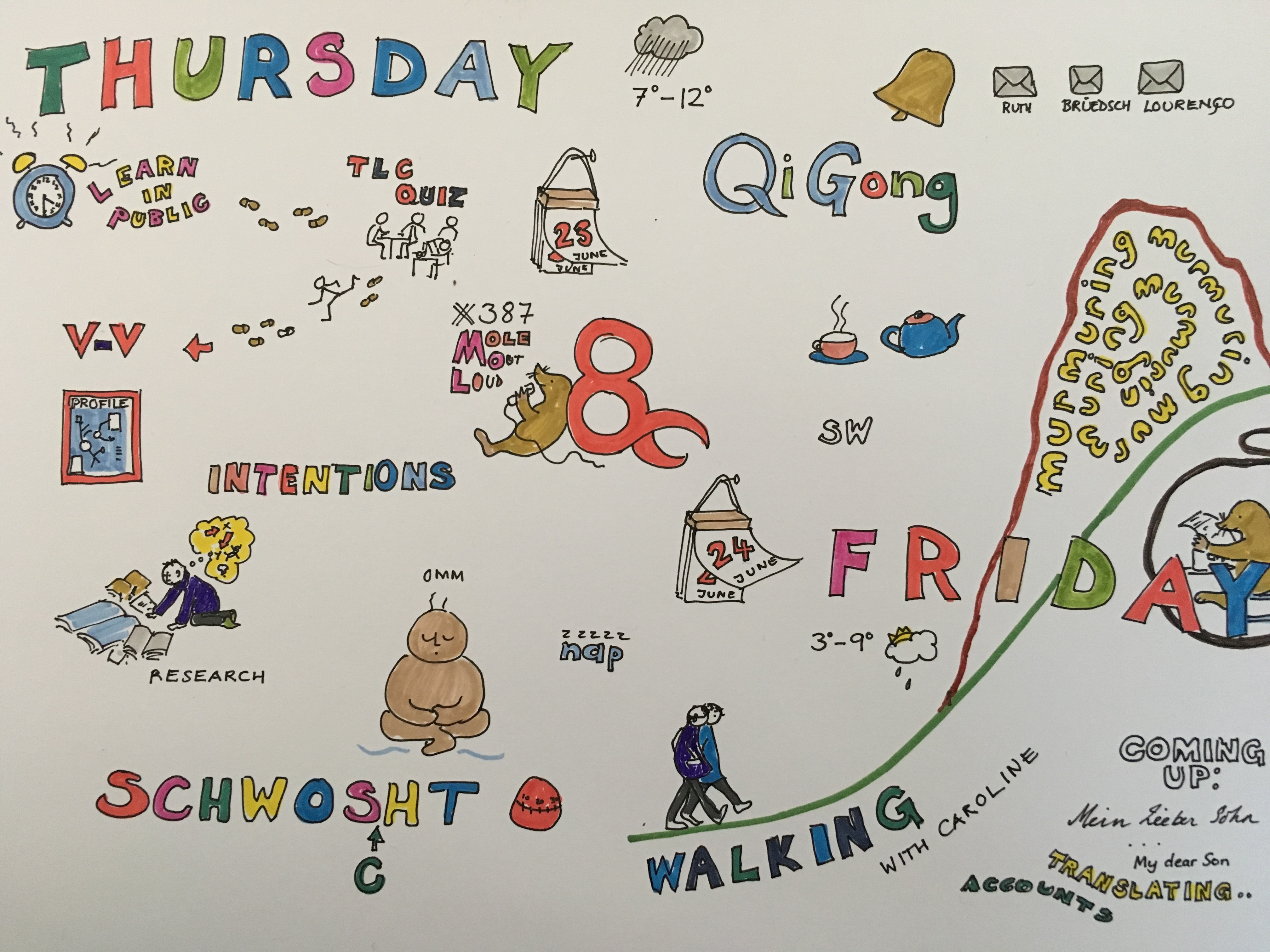
A snug day indoors drawing, researching and brainstorming, and wondering why I no longer want to use my shed.
Podcast: Play in new window | Download
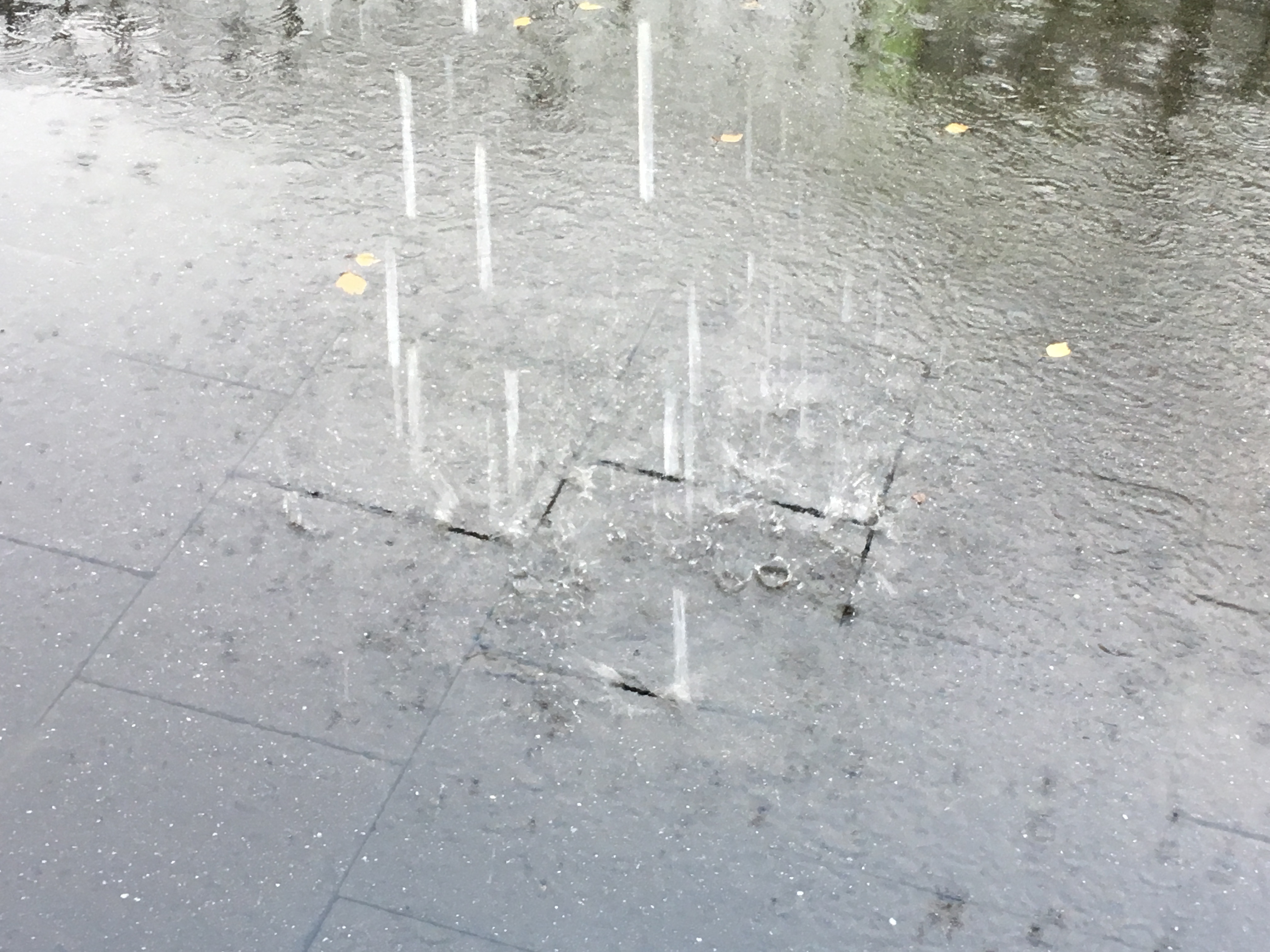
Enjoying this invigorating weather and thinking about the way the act of looking at drawn intentions, rather than written to-do lists, is processed by the right brain and bypasses second thoughts.
Podcast: Play in new window | Download